
Entrepreneurship Course — Visual Summary Infographic
An entire entrepreneurship course — from defining a startup to pitching investors — distilled into one infographic.
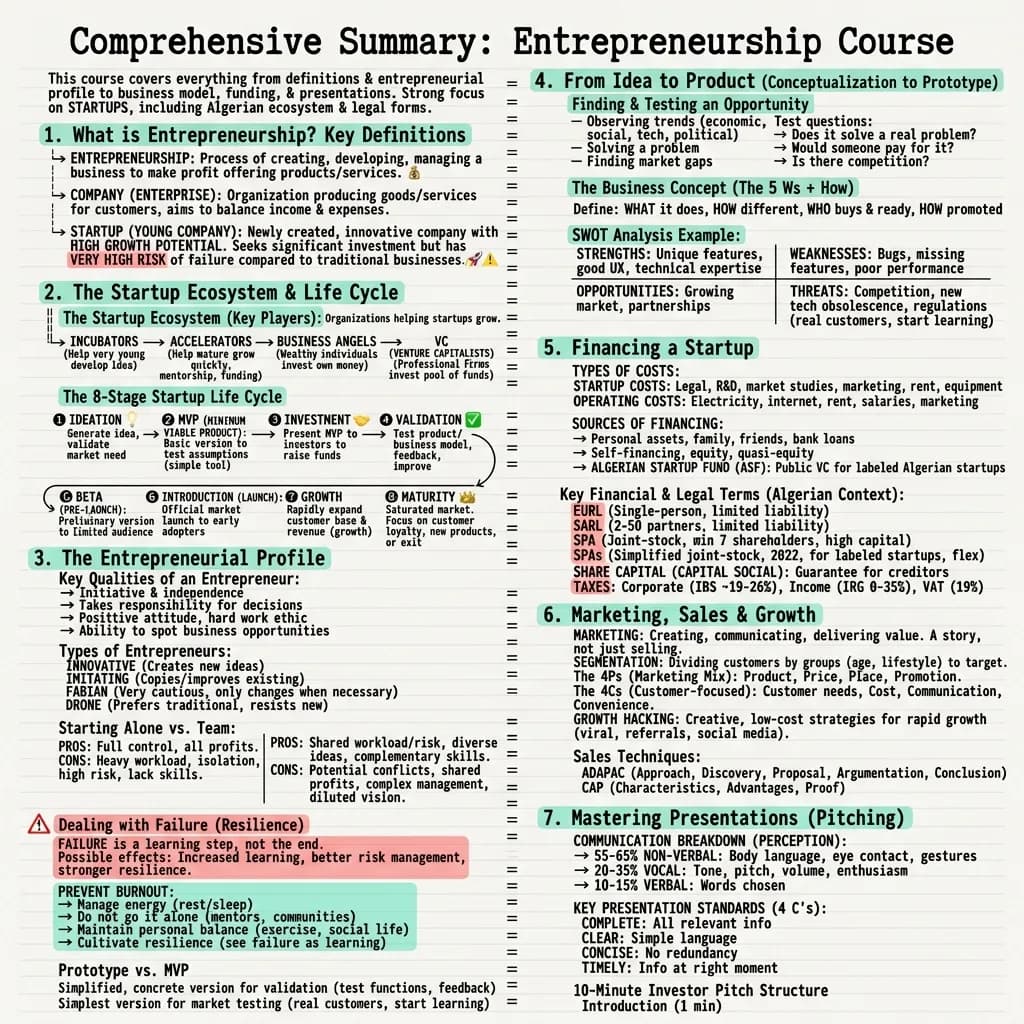
Comprehensive summary of an entrepreneurship course. Entrepreneurship is the process of creating, developing and managing a business to make a profit. A company aims to balance income and expenses; a startup is a newly created, innovative company with high growth potential, seeking significant investment but carrying a very high risk of failure. The startup ecosystem includes incubators, accelerators, business angels and venture capitalists. The startup life cycle has eight stages: ideation, MVP, investment, validation, beta, introduction, growth and maturity. The entrepreneurial profile covers initiative, responsibility, work ethic, discipline and opportunity-spotting, and types of entrepreneur: innovative, imitating, Fabian and drone. Other topics include SWOT analysis, costs and sources of financing, legal forms, marketing with the 4Ps and 4Cs, segmentation, growth hacking, sales techniques, and pitching, where communication is mostly non-verbal.
What's in this visual
An entrepreneurship course is broad rather than deep — definitions, the people who fund startups, a multi-stage life cycle, an entrepreneur's profile, then financing, marketing and pitching. Revised as pages of notes, those parts never sit together. The infographic above lays the whole course out as one map, so each topic keeps its place in the bigger picture. Here is the full breakdown.
What entrepreneurship is
Entrepreneurship is the process of creating, developing and managing a business to make a profit by offering products or services. The course turns on one distinction that runs through everything else: a company is an organisation that produces goods or services and simply aims to balance income against expenses, whereas a startup is a newly created, innovative company built for high growth. A startup seeks significant outside investment and accepts a much higher risk of failure than a traditional business — it is chasing scale, not just stability.
The startup ecosystem and its key players
A startup rarely grows alone; it sits inside an ecosystem of organisations that exist to help it. Incubators support very early-stage companies in developing and shaping the idea itself. Accelerators take slightly more mature companies and push rapid growth, usually through intensive mentorship and funding. Business angels are wealthy individuals investing their own money at an early stage. Venture capitalists (VCs) are professional firms investing large sums from a pooled fund, typically later. Knowing which player fits which stage is core to understanding how a startup is financed and supported.
The 8-stage startup life cycle
The course frames a startup's journey as eight stages. Ideation — generate the idea and confirm a market need. MVP — build a minimum viable product to test assumptions with first users. Investment — present that MVP to raise funds. Validation — test the model, gather feedback, improve. Beta — release a preliminary version to a limited audience. Introduction — officially launch to early adopters. Growth — rapidly expand customers and revenue. Maturity — the market saturates, and focus shifts to loyalty, new products or a strategic exit. The stages are sequential, which is exactly why a visual timeline beats a list.
The entrepreneurial profile
Beyond process, the course examines the person. The key qualities of an entrepreneur include initiative and independence, taking responsibility for decisions, a positive and hard-working attitude, the discipline to focus on what matters, and the ability to spot opportunities. It also classifies four types of entrepreneur: the innovative entrepreneur who creates new ideas; the imitating one who copies and improves proven models; the cautious Fabian, who changes only when forced; and the drone, who resists new methods altogether. The course also weighs starting solo against starting with a team, and treats failure as a learning step.
Financing, marketing and pitching
The final stretch of the course is practical. Financing separates one-off startup costs from ongoing operating costs, and ranges over sources from personal savings and bank loans to equity and dedicated startup funds. Marketing is framed as delivering value and telling a story, using tools such as segmentation, the 4Ps (product, price, place, promotion) and the customer-focused 4Cs. Pitching closes the course with a striking fact: in a presentation, perception is mostly non-verbal — body language and tone carry far more than the words themselves.
Why a whole course fits better on one page
A course this broad has a hidden problem: by the pitching chapter, the definition of a startup is twenty pages behind you. The parts are connected — financing depends on the life-cycle stage, the ecosystem players map onto that stage — but notes split them across a folder. A single infographic restores the whole syllabus at once, so you revise relationships, not isolated chapters. It also works as a course map: a glance shows you where any one topic sits in the larger arc from idea to exit.
For teachers
The problem
- An entrepreneurship syllabus is wide — definitions, ecosystem, life cycle, profile, finance, marketing, pitching — and students struggle to see it as one connected whole.
- The eight life-cycle stages are a sequence, but a flat list hides the order and the logic of progression.
- Learners memorise ecosystem terms like incubator and VC without grasping which belongs at which stage.
How to use it in class
- Use it as a course map on day one, then return to it as each chapter is taught.
- Project the eight-stage life cycle and walk a hypothetical startup from ideation to exit.
- Drill the ecosystem players by asking which one a startup needs at each life-cycle stage.
- Set a revision task where students rebuild the whole course outline from the infographic.
For students & visual learners
The problem
- By the time you reach pitching, the early definitions feel disconnected from everything since.
- Incubator, accelerator, business angel and VC are easy to confuse without seeing how they differ.
- The eight life-cycle stages are hard to keep in order when revised as a paragraph.
How to use it to study
- Use it as a single revision map instead of flipping through a folder of separate chapter notes.
- Follow the life-cycle timeline to lock the eight stages into the right sequence.
- Match each ecosystem player to its stage so the funding landscape finally makes sense.
- Check that you can explain every block in your own words before the exam.
Make your own visual like this
Paste your notes or upload a PDF
Drop in your own class notes, a textbook chapter or a PDF. Any subject, any language.
Pick a visual style
Choose a sketchnote, infographic or diagram style that fits the topic.
Generate and download
In about 15–40 seconds you get a one-page visual you can print, share or revise from.
Frequently asked questions
What is the difference between a startup and a company?
A company is an organisation that produces goods or services and aims to balance its income against its expenses. A startup is a newly created, innovative company built for high growth — it seeks significant outside investment and carries a much higher risk of failure than a traditional business.
What are the eight stages of the startup life cycle?
The eight stages are ideation, MVP, investment, validation, beta, introduction (launch), growth and maturity. They run in sequence, from generating and validating the idea, through building and funding the product, to launching, scaling and finally reaching a saturated market.
Can I turn a whole course PDF into one infographic?
Yes — this page was generated from a complete entrepreneurship course. Upload the course material as a PDF and VisualNote AI condenses it into a single infographic course map. Try the PDF-to-infographic tool.
More visual examples
Turn your notes into a visual
Paste any notes or upload a PDF and get a sketchnote-style visual in under a minute.