
NIST Cybersecurity Framework — Visual Explainer
The NIST Cybersecurity Framework — its five core functions and why a security framework matters — turned into one clear diagram.
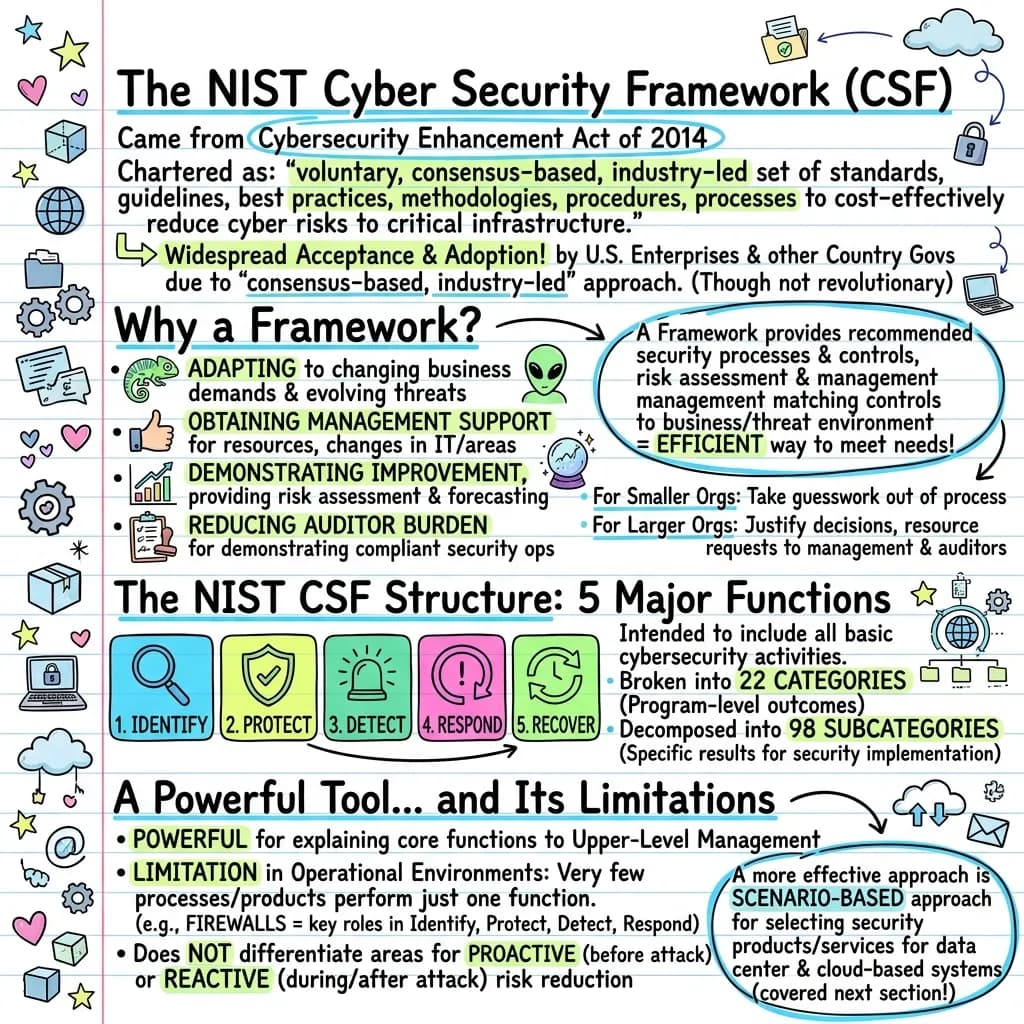
The NIST Cybersecurity Framework came out of the Cybersecurity Enhancement Act of 2014, with the charter to be a voluntary, consensus-based, industry-led set of standards, guidelines, best practices, methodologies, procedures and processes to cost-effectively reduce cyber risks to critical infrastructure. The consensus-based, industry-led approach led to widespread acceptance and adoption by US enterprises and several other governments. The top level of the framework lists five major functions of cybersecurity: identify, protect, detect, respond and recover. These functions are broken into 22 categories representing program-level outcomes, which are further decomposed into 98 subcategories listing specific required results. The identify-protect-detect-respond-recover construct is a powerful tool for explaining core functions to upper management, though in practice few processes perform just one function.
What's in this visual
The NIST Cybersecurity Framework is one of the most widely cited models in security, and it is easy to reduce to five words and lose the structure underneath. The diagram above takes the same content and lays it out as a layered model — five functions at the top, categories and subcategories below — so you see the whole framework, not just the headline. Here is the full breakdown.
What the NIST Cybersecurity Framework is
The NIST Cybersecurity Framework (CSF) is a structured, voluntary approach to managing and reducing cybersecurity risk. It is not a revolutionary new technology — it is a curated set of standards, guidelines and best practices organised so that an organisation can assess where it stands and decide what to improve. Its purpose, as written into its founding charter, is to cost-effectively reduce cyber risks to critical infrastructure. Treating it as a common language and a checklist for security maturity, rather than a product, is the right way to frame it.
Where the framework came from
The CSF emerged from the Cybersecurity Enhancement Act of 2014. Its charter called for a framework that was voluntary, consensus-based and industry-led — built with the people who would use it rather than imposed from above. That origin matters more than it first appears: because industry helped shape it, the framework earned broad acceptance and adoption, first across US enterprises and then by the governments of several other countries. The consensus process, not any single technical breakthrough, is what made the CSF a de facto standard.
The five core functions
The top level of the framework is its best-known feature: five core functions that together cover all basic cybersecurity activity. Identify — understand the systems, assets and risks you must protect. Protect — put safeguards in place to limit the impact of an event. Detect — spot a cybersecurity event when it happens. Respond — take action to contain it. Recover — restore capabilities and services afterwards. This construct is a powerful tool for explaining core security needs to senior management, because it turns a sprawling discipline into five plain, sequential ideas.
Categories and subcategories
The five functions are only the top layer. Beneath them, the framework breaks down into 22 categories — program-level outcomes that an organisation needs to maintain cybersecurity — and those in turn into 98 subcategories, each naming a specific, concrete result required to implement the right level of security. This layering is what makes the CSF usable rather than just memorable: the functions communicate the idea, while the categories and subcategories give security teams a precise, auditable list of outcomes to work towards.
Why organisations use a security framework
Whatever their maturity, security teams face the same recurring needs: adapting to evolving threats and business demands, winning management support for resources and changes, demonstrating improvement through risk assessment, and easing the burden of audits. A framework meets all four by supplying a recommended set of controls plus a risk-assessment approach to match them to the business. It removes guesswork for smaller organisations and lets larger, mature teams justify their decisions and budget requests to management and auditors.
Why frameworks are easier to learn as a diagram
The CSF is hierarchical — five functions, 22 categories, 98 subcategories — and a hierarchy only makes sense when you can see how the levels nest. A linear page of notes hides that: you end up with three separate lists and no sense of which subcategory belongs under which function. A diagram shows the tree at a glance, so 'identify' stops being a buzzword and becomes a labelled branch with concrete outcomes hanging off it. That is also how the framework is used at work — you drill down from a function to find the specific control you need.
For teachers
The problem
- The NIST CSF is easy to teach as five words and hard to teach as the layered model it actually is.
- Students learn identify-protect-detect-respond-recover by rote but cannot place categories and subcategories underneath.
- Explaining why a voluntary framework matters takes context that does not fit neatly on a slide.
How to use it in class
- Hand it out as a one-page reference before the security governance or risk management exam.
- Project it and walk through the five functions as a lifecycle, from identify to recover.
- Use the layered view to show how the 22 categories and 98 subcategories sit beneath the functions.
- Pair it with a real incident and ask students to map each action to a function.
For students & visual learners
The problem
- Learning the CSF as five buzzwords leaves you stuck when a question asks about categories or subcategories.
- Naming identify, protect, detect, respond and recover is easy; saying what each function actually does is not.
- The reasons organisations adopt a framework feel like vague background rather than examinable points.
How to use it to study
- Revise the whole framework in one glance instead of re-reading a long policy chapter.
- Use the five-function layout to recall identify-protect-detect-respond-recover as a lifecycle.
- Read the layered structure so functions, categories and subcategories stay in order.
- Keep it open as you map past-paper scenarios onto the right function and category.
Make your own visual like this
Paste your notes or upload a PDF
Drop in your own class notes, a textbook chapter or a PDF. Any subject, any language.
Pick a visual style
Choose a sketchnote, infographic or diagram style that fits the topic.
Generate and download
In about 15–40 seconds you get a one-page visual you can print, share or revise from.
Frequently asked questions
What are the five functions of the NIST Cybersecurity Framework?
The five core functions are identify, protect, detect, respond and recover. Together they cover all basic cybersecurity activity — from understanding assets and risks, through safeguarding and detecting events, to responding and restoring services afterwards.
Why do organisations adopt the NIST CSF?
Because it is voluntary, consensus-based and industry-led, the framework earned wide acceptance. Organisations use it to adapt to evolving threats, win management support for resources, demonstrate improvement through risk assessment, and reduce the burden of satisfying auditors.
Can I turn a whitepaper PDF into a visual like this?
Yes. Upload a security whitepaper or framework document as a PDF, choose a diagram style, and VisualNote AI rebuilds it as a single visual summary. Try the PDF-to-infographic tool.
More visual examples
Turn your notes into a visual
Paste any notes or upload a PDF and get a sketchnote-style visual in under a minute.