
The Animal Cell — Structure Diagram & Notes
Cell biology notes — membrane structure, organelles and transport — rebuilt as a labelled diagram instead of pages of histology prose.
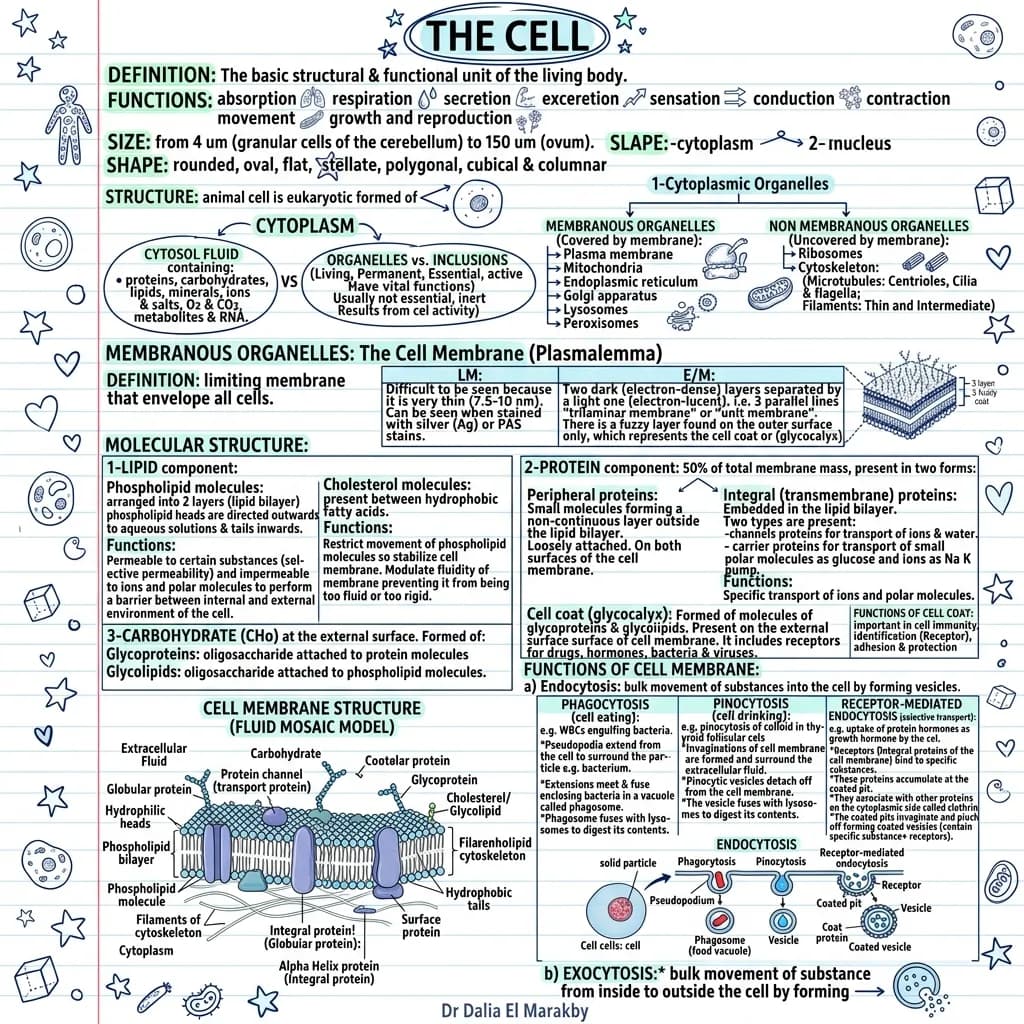
The cell is the basic structural and functional unit of the living body, performing absorption, respiration, secretion, excretion, sensation, conduction, contraction, movement, growth and reproduction. The animal cell is eukaryotic, formed of cytoplasm and a nucleus. Cytoplasm contains cytosol with proteins, carbohydrates, lipids, minerals, ions and metabolites, plus organelles and inclusions. Organelles are classified by limiting membranes into membranous types — plasma membrane, mitochondria, endoplasmic reticulum, Golgi apparatus, lysosomes, peroxisomes — and non-membranous types: ribosomes and the cytoskeleton of microtubules and filaments. The cell membrane, or plasmalemma, is a trilaminar unit membrane built from a phospholipid bilayer, cholesterol, peripheral and integral proteins, and a glycocalyx coat. It moves substances by endocytosis — phagocytosis, pinocytosis and receptor-mediated endocytosis — and by exocytosis.
What's in this visual
The animal cell is one of the first topics in any biology or histology course, and one of the most detail-dense — definitions, a list of organelles, membrane molecular structure and several transport mechanisms. The diagram above takes that same content and lays the cell out as a picture, so each organelle and membrane component sits in place. Here is the full breakdown.
What the cell is — definition and functions
The cell is the basic structural and functional unit of the living body. Despite their tiny size — from about 4 micrometres for cerebellar granule cells to 150 micrometres for the ovum — cells carry out every essential life process: absorption, respiration, secretion, excretion, sensation, conduction, contraction, movement, growth and reproduction. Cells also vary widely in shape, from rounded and flat to stellate, polygonal, cubical and columnar. The animal cell is eukaryotic, meaning it has a true membrane-bound nucleus, and it is built from two broad parts: the cytoplasm and the nucleus.
Cytoplasm: cytosol, organelles and inclusions
The cytoplasm is everything inside the cell membrane except the nucleus. It has three elements. Cytosol is the fluid ground substance, holding proteins, carbohydrates, lipids, minerals, ions, dissolved gases, metabolites and RNA. Organelles are the living, permanent, essential components with vital functions — the cell's working machinery. Inclusions are non-living, usually temporary and non-essential products of cell activity, such as stored pigment or fat. Distinguishing the permanently active organelles from the inert inclusions is a common exam point, and a labelled diagram makes the contrast obvious at a glance.
The cell membrane (plasmalemma)
The cell membrane, or plasmalemma, is the limiting membrane that envelops every cell. It is only 7.5–10 nm thick, so under the light microscope it is barely visible without silver or PAS stains; the electron microscope reveals it as a trilaminar 'unit membrane' — two dark layers around a light one. Its molecular structure has three parts: a phospholipid bilayer with cholesterol that gives selective permeability and stabilises fluidity; peripheral and integral proteins, including channel and carrier proteins for transport; and a carbohydrate cell coat (glycocalyx) carrying receptors for identification, adhesion and immunity.
Membranous vs non-membranous organelles
Organelles are classified by whether they have a limiting membrane. Membranous organelles are enclosed by membrane: the plasma membrane, mitochondria, endoplasmic reticulum, Golgi apparatus, lysosomes and peroxisomes. Non-membranous organelles lack an enclosing membrane: the ribosomes and the cytoskeleton — microtubules (including centrioles, cilia and flagella) and filaments (thin and intermediate). This single distinction organises the whole organelle list, which is why a visual that groups them into two columns is far easier to revise than a flat catalogue.
How the cell membrane moves substances
Beyond simple diffusion, the cell membrane moves material in bulk by two routes. Endocytosis brings substances in by forming vesicles, and has three forms: phagocytosis ('cell eating', as when white blood cells engulf bacteria into a phagosome), pinocytosis ('cell drinking', the uptake of fluid), and receptor-mediated endocytosis, a selective route where membrane receptors gather at a clathrin-coated pit before pinching off as a coated vesicle. Exocytosis works in reverse, releasing substances by fusing internal vesicles with the membrane.
Why cell biology is made for visual notes
Cell biology is a spatial subject taught in linear text — a definition, then a long list of organelles, then the molecular layers of a membrane, then several transport pathways. A labelled diagram restores the spatial logic: organelles sit inside the cell, the membrane's layers stack in order, and endocytosis and exocytosis read as a flow. Revising from the picture means recalling structure and process together, instead of memorising disconnected lists.
For teachers
The problem
- The animal cell packs a definition, an organelle catalogue, membrane molecular structure and several transport mechanisms into one early lesson.
- Students memorise the organelle list but cannot say which are membranous and which are not.
- Endocytosis and its three subtypes are hard to convey clearly with words alone on a board.
How to use it in class
- Hand it out as a one-page summary at the start of the cell biology unit.
- Project it and label organelles live, grouping them into membranous and non-membranous.
- Use the membrane cross-section to teach the bilayer, proteins and glycocalyx in order.
- Turn the endocytosis panel into a worksheet by blanking the three subtypes for recall.
For students & visual learners
The problem
- Histology notes on the cell are dense, and every organelle and membrane layer feels examinable.
- You can list the organelles but freeze when asked to sort them into membranous and non-membranous.
- Phagocytosis, pinocytosis and receptor-mediated endocytosis blur together the night before the test.
How to use it to study
- Revise the whole cell in one glance instead of re-reading pages of histology.
- Use the two-column organelle grouping to lock in the membranous-versus-non-membranous distinction.
- Follow the transport panel to recall the three forms of endocytosis in order.
- Stick it above your desk so the layout of the cell sinks in passively.
Make your own visual like this
Paste your notes or upload a PDF
Drop in your own class notes, a textbook chapter or a PDF. Any subject, any language.
Pick a visual style
Choose a sketchnote, infographic or diagram style that fits the topic.
Generate and download
In about 15–40 seconds you get a one-page visual you can print, share or revise from.
Frequently asked questions
What is a cell?
A cell is the basic structural and functional unit of the living body. The animal cell is eukaryotic — it has a true membrane-bound nucleus — and is built from cytoplasm and a nucleus, carrying out processes such as respiration, secretion, growth and reproduction.
What is the difference between membranous and non-membranous organelles?
Membranous organelles are enclosed by a limiting membrane — the plasma membrane, mitochondria, endoplasmic reticulum, Golgi apparatus, lysosomes and peroxisomes. Non-membranous organelles lack an enclosing membrane: the ribosomes and the cytoskeleton of microtubules and filaments.
What is endocytosis?
Endocytosis is the bulk movement of substances into the cell by forming vesicles. It has three forms: phagocytosis (cell eating), pinocytosis (cell drinking) and receptor-mediated endocytosis. You can turn your own biology notes into a diagram like this with VisualNote AI.
More visual examples
Turn your notes into a visual
Paste any notes or upload a PDF and get a sketchnote-style visual in under a minute.