
Ear & Vestibular Apparatus — Anatomy Diagram & Notes
MBBS-level ear anatomy — from the pinna to the vestibular apparatus, with blood supply, nerve supply and clinical correlations — compressed into one revisable diagram.
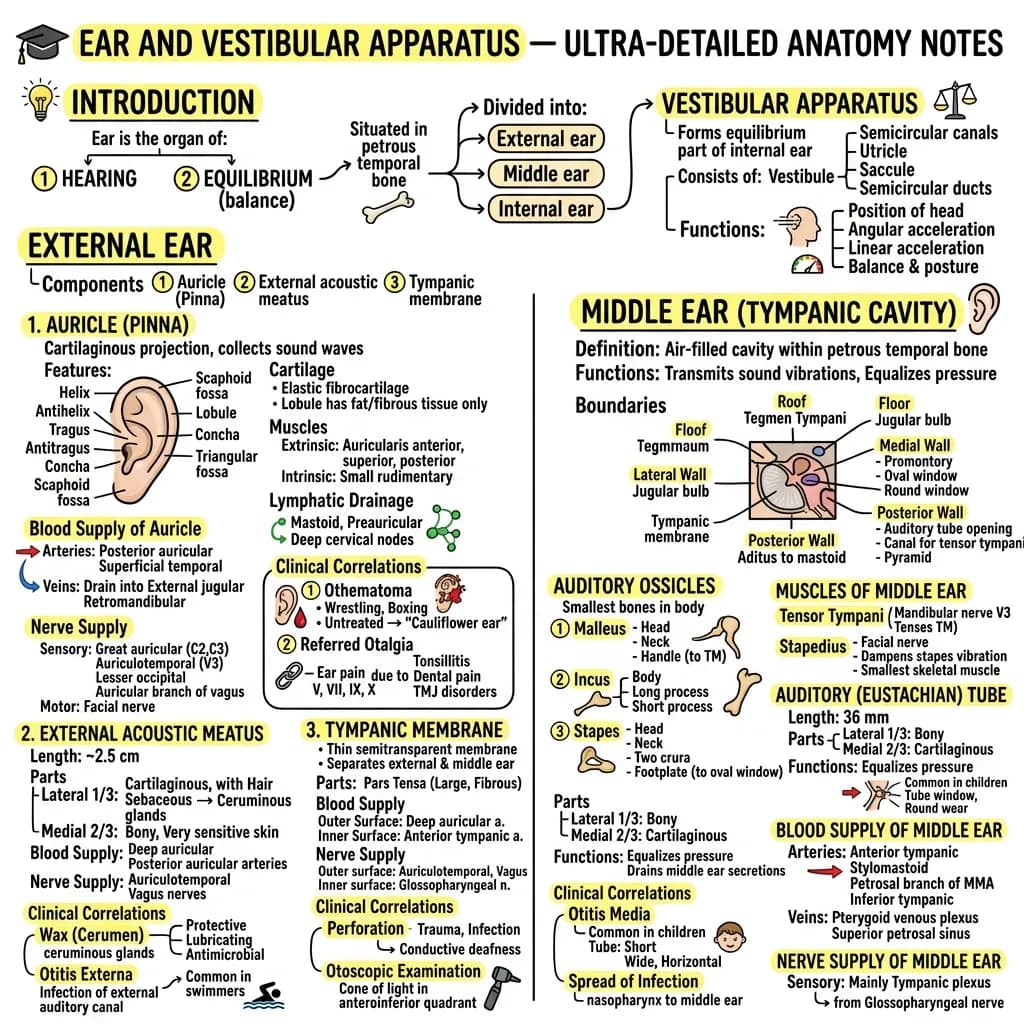
The ear is the organ of hearing and equilibrium, situated in the petrous temporal bone and divided into external, middle and internal ear. External ear: auricle (elastic fibrocartilage, helix, antihelix, tragus, concha, lobule), external acoustic meatus (about 2.5 cm, cartilaginous lateral third, bony medial two-thirds), tympanic membrane (pars tensa and pars flaccida, three layers, umbo). Middle ear: an air-filled tympanic cavity with roof tegmen tympani, medial wall bearing promontory, oval and round windows; auditory ossicles malleus, incus and stapes; tensor tympani and stapedius muscles; auditory tube. Internal ear holds the vestibular apparatus — vestibule, semicircular canals, utricle and saccule — for balance. Blood supply, nerve supply and clinical correlations such as otitis media accompany each region.
What's in this visual
Ear anatomy is a classic MBBS topic: a lot of structures, a strict regional order and exam questions on every blood vessel and nerve. The diagram above takes the same BD Chaurasia-style content and lays it out spatially — external, middle and inner ear in sequence — so the structures sit where they actually belong. Here is the full breakdown.
The three divisions of the ear
The ear is the organ of both hearing and equilibrium, housed in the petrous part of the temporal bone. Anatomically it splits into three parts: the external ear, which collects sound; the middle ear, an air-filled cavity that transmits and amplifies vibration; and the internal ear, which converts vibration into nerve signals and houses the vestibular apparatus for balance. Learning the ear in this external-to-internal order is the single most useful framing, because every structure, vessel and nerve belongs to one of the three divisions.
The external ear
The external ear has three components: the auricle, the external acoustic meatus and the tympanic membrane. The auricle (pinna) is a projection of elastic fibrocartilage — with named features such as the helix, antihelix, tragus and concha — except the lobule, which holds only fat and fibrous tissue. The external acoustic meatus is roughly 2.5 cm long, with a cartilaginous lateral third and a bony medial two-thirds. The tympanic membrane is a thin three-layered membrane, divided into pars tensa and pars flaccida, with the handle of the malleus attached at the umbo.
The middle ear and the auditory ossicles
The middle ear, or tympanic cavity, is an air-filled space in the petrous temporal bone that transmits sound and equalises pressure. Its six walls are exam favourites — the roof is the tegmen tympani, the lateral wall is the tympanic membrane, and the medial wall carries the promontory, oval window and round window. Inside sit the three smallest bones in the body, the auditory ossicles: the malleus, incus and stapes, whose footplate fits the oval window. Two tiny muscles — tensor tympani and stapedius — dampen excessive vibration, and the auditory (Eustachian) tube links the cavity to the nasopharynx.
The inner ear and the vestibular apparatus
The internal ear lies deepest, within the petrous temporal bone. Its equilibrium portion is the vestibular apparatus, made up of the vestibule, the three semicircular canals, the utricle and the saccule, together with the semicircular ducts. This apparatus detects head position, angular and linear acceleration, and helps maintain balance and posture — the semicircular canals sensing rotation while the utricle and saccule respond to linear movement and gravity. Pairing these structures with the cochlea, the organ of hearing, completes the picture of the inner ear as a dual sensory organ.
Blood supply, nerve supply and clinical correlations
Anatomy exams rarely stop at structure — they ask for vessels, nerves and clinical links. The auricle is supplied by the posterior auricular and superficial temporal arteries; the middle ear by branches such as the anterior tympanic and stylomastoid arteries. Sensory innervation is shared across cranial nerves V, VII, IX and X, which explains referred otalgia — ear pain arising from tonsillitis, dental disease or TMJ disorders. Other classic correlations include othematoma and 'cauliflower ear', tympanic membrane perforation causing conductive deafness, and otitis media, which is common in children because their auditory tube is short, wide and horizontal.
Why anatomy is the ideal subject for visual notes
Anatomy is inherently spatial, yet textbooks describe it in linear prose — paragraph after paragraph of structures, walls, vessels and nerves. A labelled diagram puts every structure back where it belongs, so the external, middle and inner ear, the ossicle chain and the vestibular apparatus are seen in relation to one another. For revision you scan the layout instead of re-reading pages, and the clinical correlations attach naturally to the structures they affect.
For teachers
The problem
- Ear anatomy spans three divisions, dozens of named structures and four cranial nerves — far too much for a single legible board sketch.
- Students learn the ossicles and walls as isolated lists and lose the spatial relationship between external, middle and inner ear.
- Drawing an accurate, labelled ear diagram from scratch for every cohort eats into limited prep time.
How to use it in class
- Hand it out as a one-page revision sheet before the head-and-neck anatomy viva.
- Project it and walk the class from the pinna inward, one division at a time.
- Attach the clinical correlations — otitis media, perforation, referred otalgia — to the structures as you teach them.
- Blank out the ossicles or the middle-ear walls to turn the diagram into a labelling exercise.
For students & visual learners
The problem
- BD Chaurasia-style chapters are exhaustive, and every vessel, nerve and wall feels like a possible viva question.
- You can name the malleus, incus and stapes but blank on which window each connects to.
- Blood supply and nerve supply blur together because the notes list them separately from the structures.
How to use it to study
- Revise the whole ear in one glance instead of re-reading a long anatomy chapter.
- Use the external-to-internal layout to recall structures in the order an examiner expects.
- Trace the ossicle chain visually so the malleus-incus-stapes sequence sticks.
- Pin it above your desk so the regional anatomy sinks in before the practical exam.
Make your own visual like this
Paste your notes or upload a PDF
Drop in your own class notes, a textbook chapter or a PDF. Any subject, any language.
Pick a visual style
Choose a sketchnote, infographic or diagram style that fits the topic.
Generate and download
In about 15–40 seconds you get a one-page visual you can print, share or revise from.
Frequently asked questions
What are the three parts of the ear?
The ear is divided into the external ear (auricle, external acoustic meatus and tympanic membrane), the middle ear (the air-filled tympanic cavity with the auditory ossicles), and the internal ear (the cochlea for hearing and the vestibular apparatus for balance).
What is the vestibular apparatus?
The vestibular apparatus is the equilibrium part of the internal ear. It consists of the vestibule, the three semicircular canals, the utricle and the saccule, and it detects head position, angular and linear acceleration, and helps maintain balance and posture.
Can I turn a textbook chapter PDF into a diagram like this?
Yes. Upload an anatomy chapter as a PDF, pick a diagram style, and VisualNote AI rebuilds it as a single labelled visual. Try the PDF-to-infographic tool.
More visual examples
Turn your notes into a visual
Paste any notes or upload a PDF and get a sketchnote-style visual in under a minute.