
Rheumatic Heart Disease — Visual Case Summary
A medical journal article on rheumatic heart disease in Pakistan, turned into a clear visual summary of causes, screening and impact.
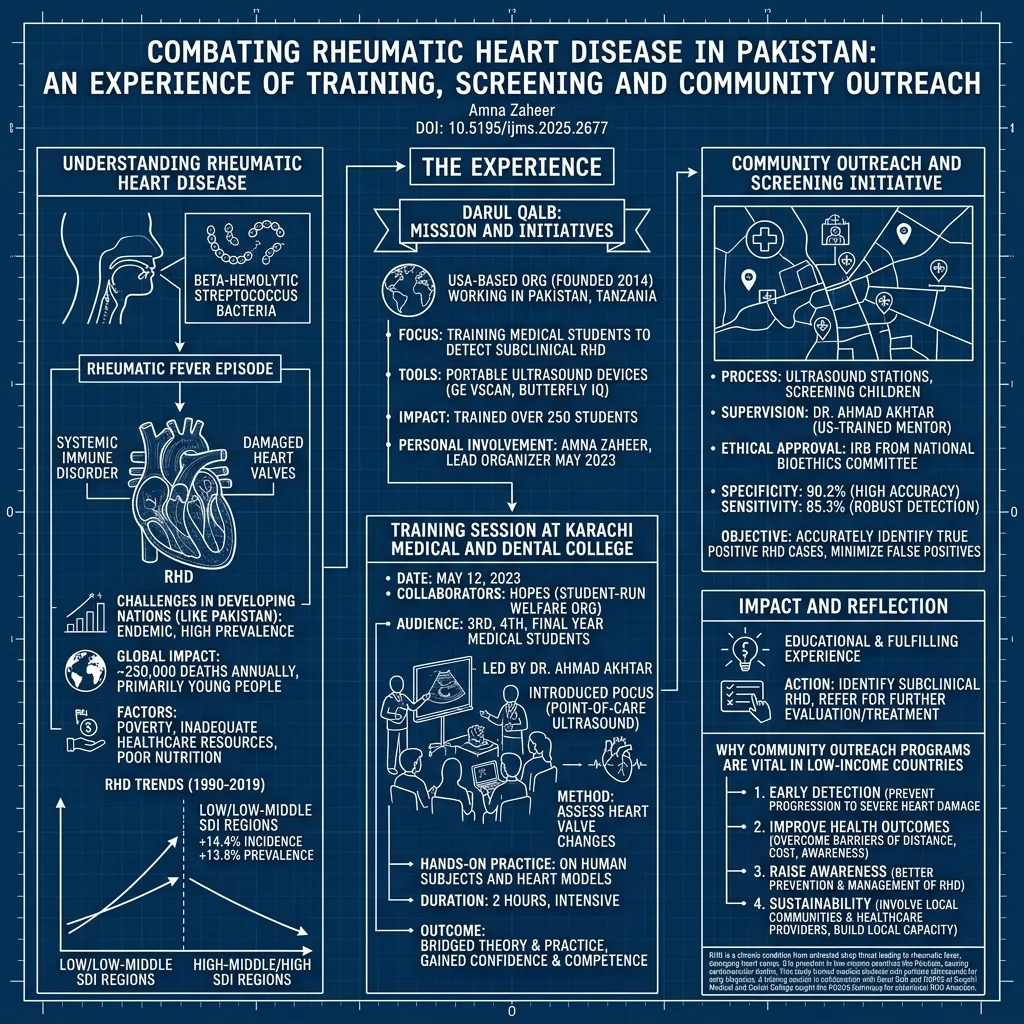
Rheumatic heart disease is a systemic immune disorder that follows rheumatic fever, typically caused by a throat infection with beta-haemolytic streptococcus bacteria. It remains endemic in developing nations such as Pakistan and contributes to roughly 250,000 deaths a year worldwide. Prevalence is high among children and young adults in low-income countries because of poverty, inadequate healthcare and poor nutrition, and incidence rose between 1990 and 2019 in low Socio-Demographic Index regions. Darul Qalb, a US-based organisation founded in 2014, trains medical students to detect subclinical RHD using portable ultrasound devices such as the GE Vscan and Butterfly iQ. A training session at Karachi Medical and Dental College taught the Point-of-Care Ultrasound technique. Community outreach screening followed, with reported specificity of about 90% and sensitivity of about 85%, enabling early detection and referral.
What's in this visual
A medical journal article packs causes, epidemiology, a screening method and a public-health argument into continuous text, and the through-line is easy to lose. The visual above keeps the article's logic intact: what rheumatic heart disease is, how widely it harms, how it can be caught early, and why community screening works. Here is the full breakdown.
What rheumatic heart disease is
Rheumatic heart disease (RHD) is a systemic immune disorder that develops after an episode of rheumatic fever. The chain begins with something common: an untreated throat infection caused by group A beta-haemolytic streptococcus. The body's immune response to that infection can mistakenly attack its own tissues, and the lasting damage settles in the heart valves. What started as a sore throat becomes chronic valve disease — which is why RHD is fundamentally a preventable condition, treatable at the streptococcal stage long before the heart is harmed.
The global burden of RHD
RHD is overwhelmingly a disease of inequality. It contributes to roughly 250,000 deaths worldwide each year and remains a major cause of cardiovascular death and disability in low- and middle-income regions — particularly South Asia, the Pacific islands and Sub-Saharan Africa. Its victims are mainly children and young adults, and the drivers are social: poverty, overcrowding, poor nutrition and limited access to healthcare. Tellingly, between 1990 and 2019 incidence and prevalence fell in high-income regions but rose in the poorest ones — proof that RHD persists where basic care is hardest to reach.
Screening with point-of-care ultrasound
Early RHD is usually subclinical — present and damaging valves, but causing no symptoms a patient would notice. The article describes a practical answer: Point-of-Care Ultrasound (POCUS) using portable, affordable devices such as the GE Vscan and Butterfly iQ. These hand-held scanners let a trained operator examine the heart valves outside a hospital, in a classroom or a community setting. The reported screening performance is strong — around 90% specificity and 85% sensitivity — meaning it reliably identifies genuine cases while keeping false positives low.
Training and community outreach
Technology alone detects nothing without trained operators, so the initiative is built around capacity-building. Darul Qalb, a US-based organisation founded in 2014, has trained over 250 medical students to detect subclinical RHD. A hands-on training session at Karachi Medical and Dental College taught students the POCUS technique on both heart models and real subjects. Trained students then ran community outreach screening, taking ultrasound stations directly to children — bridging theory and practice, and bringing diagnosis to populations that would not otherwise reach a cardiologist.
Why early detection matters
The whole effort rests on a simple logic: catching RHD early changes the outcome. Detected at the subclinical stage, a child can be referred for treatment before the valve damage becomes severe or fatal. Community outreach amplifies this by overcoming the real barriers — distance, cost, lack of awareness — that leave RHD undiagnosed in low-income regions. Crucially, by training local medical students rather than flying in specialists, the programme builds lasting local capacity, so the screening effort can continue and the health benefit is sustainable.
Why medical research is clearer as a visual summary
A research article is written for completeness — methods, statistics, caveats and citations all interwoven — which is exactly why its core argument can be hard to hold. A visual summary lifts the spine of the paper into view: cause, burden, method, result, significance. For a student, that turns a journal article into something revisable; for an educator, it becomes a teaching slide. The detail still lives in the paper — the visual is the map that makes the detail navigable.
For teachers
The problem
- A journal article interleaves pathophysiology, epidemiology, method and statistics, so students lose the single argument running through it.
- It is hard to convey why a sore-throat infection and a damaged heart valve are stages of the same disease.
- Screening statistics such as sensitivity and specificity stay abstract when read away from a real screening programme.
How to use it in class
- Use it as a journal-club aid so the class grasps the paper's structure before discussing the detail.
- Trace the causal chain from streptococcal infection to valve damage as a single teaching narrative.
- Anchor a lesson on sensitivity and specificity to the real POCUS screening figures shown here.
- Set students to expand each block back into a full paragraph, checking their reading of the source.
For students & visual learners
The problem
- Research papers are slow going, and the main thread is buried under methods and references.
- The link between a streptococcal throat infection and chronic heart-valve disease is easy to state but hard to truly follow.
- Public-health points — burden, outreach, sustainability — feel like background rather than examinable content.
How to use it to study
- Read the visual first to fix the paper's argument, then read the article for the supporting detail.
- Follow the cause chain so you can explain RHD from sore throat to valve damage without notes.
- Use it to revise screening concepts against concrete sensitivity and specificity figures.
- Compare it with the original article to learn how to summarise a paper down to its spine.
Make your own visual like this
Paste your notes or upload a PDF
Drop in your own class notes, a textbook chapter or a PDF. Any subject, any language.
Pick a visual style
Choose a sketchnote, infographic or diagram style that fits the topic.
Generate and download
In about 15–40 seconds you get a one-page visual you can print, share or revise from.
Frequently asked questions
What causes rheumatic heart disease?
Rheumatic heart disease follows rheumatic fever, which is itself triggered by an untreated throat infection with group A beta-haemolytic streptococcus bacteria. The immune response to that infection can damage the heart valves, producing chronic, often preventable, valve disease.
How is subclinical RHD detected?
Subclinical RHD causes no obvious symptoms, so it is found by screening rather than by complaint. Trained operators use Point-of-Care Ultrasound with portable devices such as the GE Vscan and Butterfly iQ to examine the heart valves, with reported specificity around 90% and sensitivity around 85%.
Can VisualNote AI summarise a research paper?
Yes — this page was generated from a medical journal article. Upload a paper as a PDF and VisualNote AI rebuilds its core argument as a single visual summary you can revise from or teach with. Try the PDF-to-infographic tool.
More visual examples
Turn your notes into a visual
Paste any notes or upload a PDF and get a sketchnote-style visual in under a minute.