Molecular Biology Fundamentals — Visual Notes
The genetic code, mutations and DNA structure — a whole molecular-biology chapter compressed into one infographic.
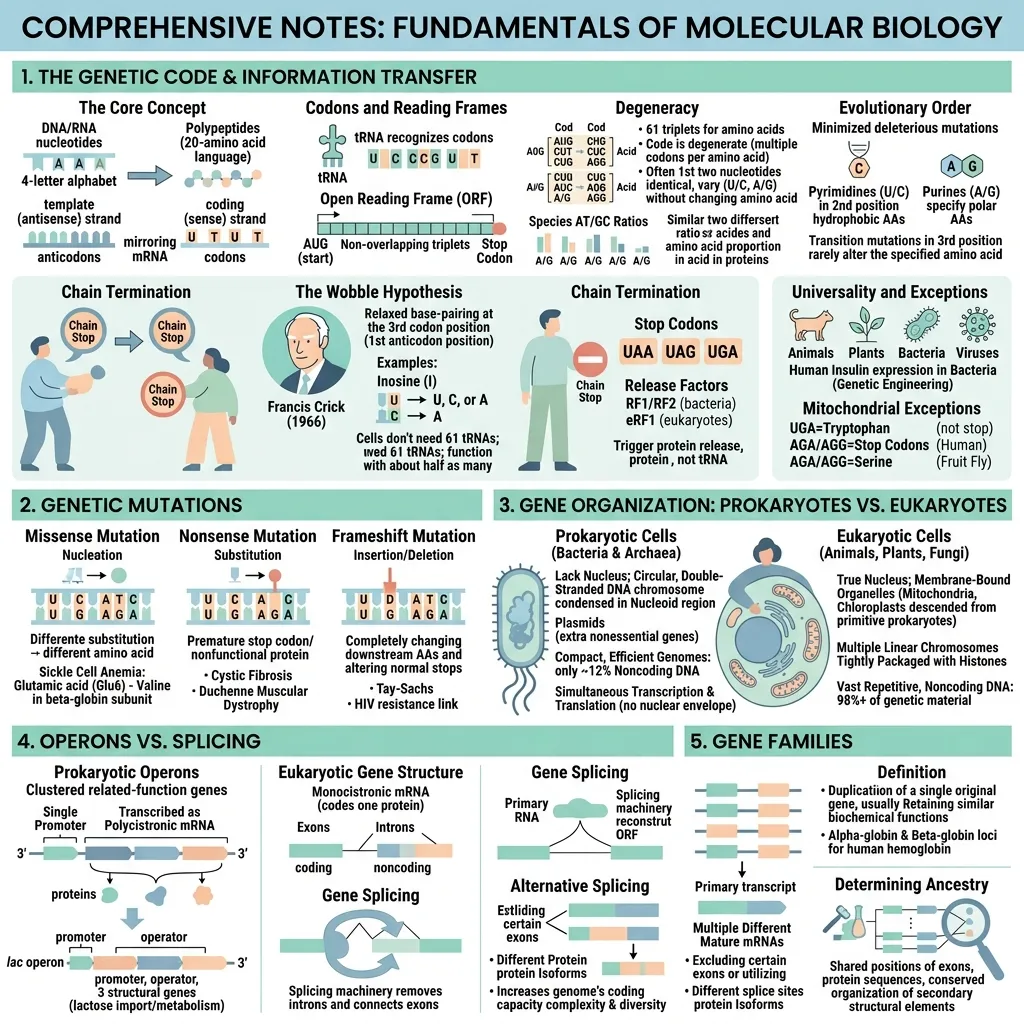
The genetic code transfers information from the four-letter alphabet of DNA and RNA nucleotides into the twenty-amino-acid language of polypeptides. tRNA reads triplets called codons; the sequence between a start codon AUG and a stop codon is an open reading frame. The code is degenerate — 61 triplets specify amino acids, most by more than one codon — and the wobble hypothesis, proposed by Crick in 1966, relaxes pairing at the third position. Point mutations alter the coding sequence: missense changes an amino acid, nonsense creates a premature stop, frameshift indels shift the reading frame. Prokaryotes have a circular chromosome in a nucleoid and cluster genes into operons; eukaryotes have linear chromosomes, introns and exons, and use splicing. DNA is a double helix, described by Watson and Crick in 1953, obeying Chargaff's base-pairing rules.
What's in this visual
Molecular biology is one of the densest chapters in any biology course — the genetic code, mutation types, gene organisation and DNA structure, each with its own vocabulary. The infographic above takes that whole chapter and lays it out as connected sections, so the concepts sit next to each other instead of stacking up across pages. Here is the full breakdown.
The genetic code and information transfer
The genetic code is the rule set that transfers information from the four-letter alphabet of DNA and RNA nucleotides into the twenty-amino-acid language of proteins. Transfer RNA reads the code in codons — non-overlapping triplets of nucleotides — and the stretch between a start codon (AUG) and a stop codon is an open reading frame. The code is degenerate: 61 triplets specify amino acids, and most amino acids are encoded by several synonymous codons. It is also almost universal across all life, which is exactly what makes genetic engineering — such as making human insulin in bacteria — possible.
Genetic mutations: missense, nonsense and frameshift
A gene's coding sequence can be permanently altered by mutation, and three point-mutation types are essential to know. A missense mutation substitutes one nucleotide so a different amino acid is inserted — sickle cell anaemia, where valine replaces glutamic acid, is the classic example. A nonsense mutation creates a premature stop codon, producing a truncated, usually non-functional protein, as in some cases of cystic fibrosis. A frameshift mutation is an insertion or deletion that shifts the reading frame, scrambling every downstream amino acid; it causes Tay-Sachs disease but has also been linked to HIV resistance.
Gene organisation: prokaryotes vs eukaryotes
Genes are organised very differently in the two cell types. Prokaryotes — bacteria and archaea — keep a single circular chromosome condensed in a region called the nucleoid, often carry extra genes on circular plasmids, and have compact genomes where only about 12% of the DNA is non-coding; with no nuclear envelope, transcription and translation happen at the same time. Eukaryotes have a true nucleus, multiple linear chromosomes packaged with histones, and vast amounts of repetitive non-coding DNA — upwards of 98% of the genome.
Operons, exons, introns and splicing
Because of those organisational differences, prokaryotes and eukaryotes regulate genes differently. Prokaryotes cluster related genes into operons — a single promoter driving a polycistronic mRNA that codes for several proteins, as in the classic lac operon. Eukaryotic mRNAs are usually monocistronic, and their coding sequences (exons) are interrupted by non-coding introns. After transcription, splicing removes the introns and joins the exons; alternative splicing lets a single transcript yield several different proteins, hugely expanding a genome's coding capacity.
DNA structure and the double helix
Underlying all of this is the structure of DNA itself. In 1953, James Watson and Francis Crick described DNA as a double helix, work that won a Nobel Prize in 1962 shared with Maurice Wilkins. The critical evidence came from Rosalind Franklin's X-ray crystallography images, which revealed the helical shape. The pairing itself follows Chargaff's rules: within any species the amount of adenine equals thymine, and guanine equals cytosine — the observation that showed the bases pair up across the two strands.
Why dense biology chapters need visual notes
Molecular biology overloads plain notes: a chapter introduces the genetic code, mutation types, prokaryotic and eukaryotic organisation, splicing and DNA structure, each with its own dense terminology. An infographic gives every section its own visual block, so the relationships — code to mutation, organisation to splicing — are seen rather than inferred. For revision you scan the layout and recall the chapter as a connected map, not as pages of definitions read in isolation.
For teachers
The problem
- Molecular biology stacks five major topics — genetic code, mutations, gene organisation, splicing, DNA structure — into one demanding chapter.
- Students learn the mutation types as definitions and cannot match each one to its disease example.
- The prokaryote-versus-eukaryote contrast is spread across pages, so the parallels never line up clearly.
How to use it in class
- Hand it out as a one-page chapter summary before the molecular biology exam.
- Project it and unpack one section at a time, from the genetic code to DNA structure.
- Use the mutation panel to drill missense, nonsense and frameshift with their disease examples.
- Blank the prokaryote-versus-eukaryote rows to make a quick comparison worksheet.
For students & visual learners
The problem
- The chapter is terminology-heavy — codons, ORFs, wobble, operons, introns — and every term feels examinable.
- Missense, nonsense and frameshift mutations blur together when revised as a paragraph.
- You can define an operon and an intron but lose track of which belongs to prokaryotes and which to eukaryotes.
How to use it to study
- Revise the whole molecular biology chapter in one glance instead of re-reading pages.
- Use the mutation block to fix missense, nonsense and frameshift to their disease examples.
- Read the prokaryote-versus-eukaryote sections side by side so the contrast holds.
- Pin it above your desk so the dense terminology sinks in before the exam.
Make your own visual like this
Paste your notes or upload a PDF
Drop in your own class notes, a textbook chapter or a PDF. Any subject, any language.
Pick a visual style
Choose a sketchnote, infographic or diagram style that fits the topic.
Generate and download
In about 15–40 seconds you get a one-page visual you can print, share or revise from.
Frequently asked questions
What is the genetic code?
The genetic code is the set of rules that transfers information from the four-letter nucleotide alphabet of DNA and RNA into the twenty-amino-acid language of proteins. tRNA reads it in non-overlapping triplets called codons, and the code is degenerate and almost universal across all life.
What is the difference between a missense and a nonsense mutation?
A missense mutation substitutes a nucleotide so a different amino acid is inserted into the protein, as in sickle cell anaemia. A nonsense mutation creates a premature stop codon, producing a truncated, usually non-functional protein.
What is the wobble hypothesis?
Proposed by Francis Crick in 1966, the wobble hypothesis states that base-pairing rules are relaxed at the third position of a codon. This lets a single tRNA recognise several codons, so cells need far fewer than 61 different tRNAs. You can turn a chapter like this into an infographic with VisualNote AI.
More visual examples
Turn your notes into a visual
Paste any notes or upload a PDF and get a sketchnote-style visual in under a minute.