
Car Engine Parts & Basics — Visual Diagram
The fundamentals of a gasoline engine — block, cylinders, pistons and how they connect — turned into one labelled diagram for exam revision.
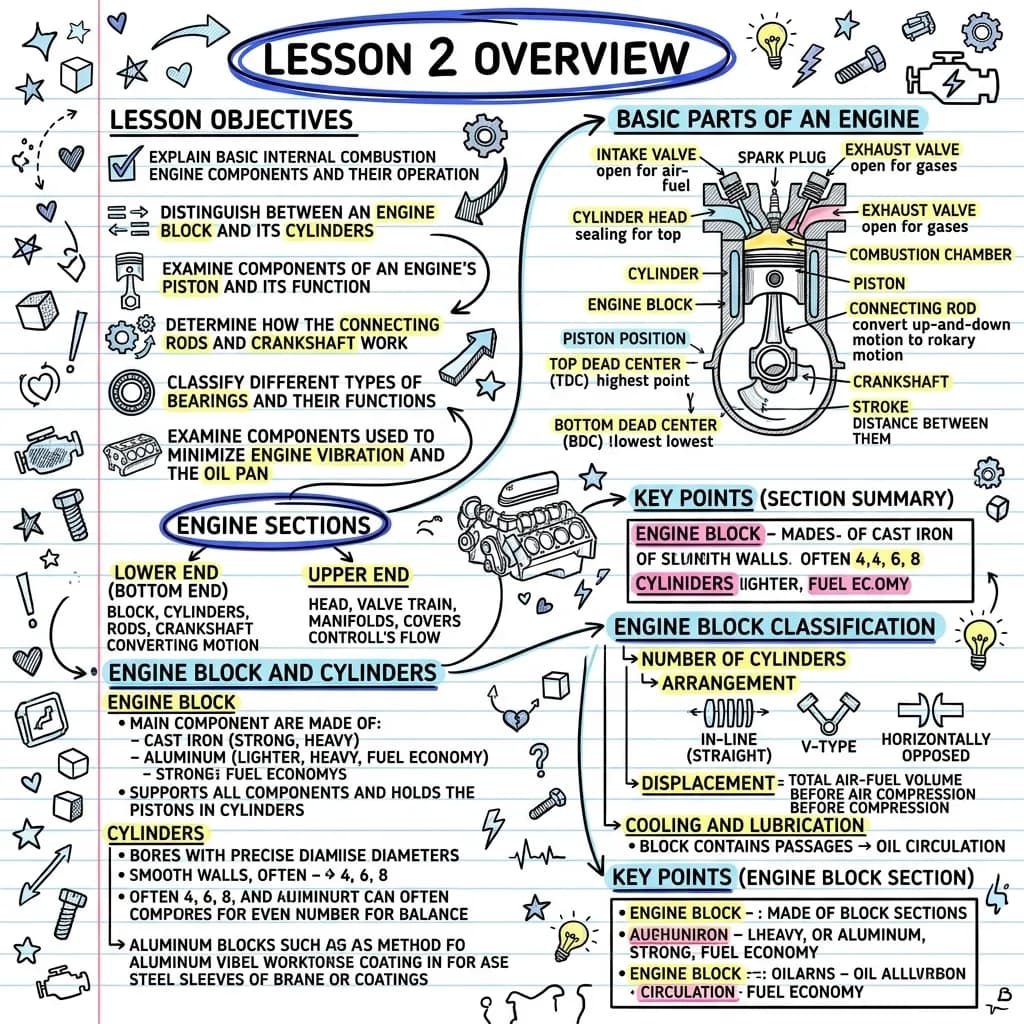
Lesson on the basics of a gasoline engine. An automotive engine produces power by burning air and fuel inside a closed cylinder, a hollow metal tube drilled into the engine block. The cylinder head seals the top and holds the intake valve, which admits the mixture, and the exhaust valve, which releases burnt gases. The piston moves up and down; the spark plug ignites the mixture in the combustion chamber above it. The piston connects to the crankshaft through the connecting rod, converting reciprocating motion into rotary motion. Top Dead Centre is the piston's highest position, Bottom Dead Centre the lowest; the stroke is the distance between them. The engine splits into lower and upper ends. The block, cast from iron or aluminium, is classified by cylinder count and arrangement: in-line, V-type or horizontally opposed.
What's in this visual
A gasoline engine is the textbook case of a topic that resists plain notes — it is a set of physical parts in fixed spatial relationships, described in a chapter as one part after another. The diagram above puts each component back where it sits in the engine, so the block, cylinders, piston and crankshaft are seen connected. Here is the full breakdown.
How a gasoline engine produces power
An automotive engine produces power by burning a mixture of air and fuel inside a closed cylinder. The sequence is tightly choreographed. The intake valve opens to admit the air-and-fuel mixture; both valves then close so the cylinder is sealed; the spark plug ignites the mixture in the combustion chamber above the piston; the rapid burn drives the piston down; and the exhaust valve opens to release the burnt gases. Every part of the engine exists to make, repeat or harness that controlled explosion.
The basic parts of an engine
A handful of core parts do the essential work. The engine block houses the cylinders — hollow metal tubes drilled into it — and the cylinder head seals each cylinder from the top and carries the intake and exhaust valves. Inside each cylinder, the can-shaped piston moves up and down. The piston is joined to the crankshaft by the connecting rod, and that pairing does the engine's defining trick: it converts the piston's up-and-down motion into the rotary motion that ultimately turns the wheels. The spark plug supplies the ignition.
Piston position terms: TDC, BDC and stroke
Because the piston is the main moving part, three terms describe its travel and they appear constantly in engine questions. Top Dead Centre (TDC) is the highest position the piston reaches inside the cylinder. Bottom Dead Centre (BDC) is its lowest position. The stroke is the total distance the piston travels between those two points, top to bottom. These are not just labels — TDC, BDC and stroke are the reference points used to define how an engine actually operates, so fixing them visually pays off across the whole topic.
The lower end and the upper end
An engine is conventionally divided into two assemblies, and learning it this way keeps the part list organised. The lower end (or bottom end) contains the engine block, cylinders, pistons, connecting rods and crankshaft; its job is to convert piston motion into rotary motion. The upper end contains the cylinder head, valves, valve train, manifolds and engine covers; its job is to control the flow of the air-and-fuel mixture in and the exhaust gases out. Every component belongs to one assembly or the other — a clean way to structure revision.
The engine block and cylinders
The engine block is the main component — the solid foundation that supports everything else, cast from cast iron (strong, easy to mass-produce, but heavy) or aluminium (lighter, improving fuel economy). The cylinders are deep, can-shaped holes bored into the block, properly called the cylinder bore, with smooth, precisely machined walls so the pistons slide freely. Engines typically have 4, 6 or 8 cylinders — an even number, for balance — and blocks are classified by cylinder count and by arrangement: in-line, V-type or horizontally opposed.
Why mechanical topics need a labelled diagram
An engine is a three-dimensional object, so describing it in linear text fights its very nature — the reader has to rebuild the machine in their head, part by part. A labelled diagram skips that: the piston is shown inside the cylinder, the connecting rod linking it to the crankshaft, the lower and upper ends visibly stacked. Understanding follows naturally when the spatial relationships are on the page, and that understanding is the genuine first step toward diagnosing a real engine — not just naming its parts.
For teachers
The problem
- An engine is a spatial machine, but a textbook describes it one part at a time, so students never see how the parts fit together.
- Learners memorise TDC, BDC and stroke as definitions without connecting them to the piston's actual travel.
- The lower-end and upper-end split is a tidy structure that gets lost in a long, undivided parts list.
How to use it in class
- Anchor the lesson on the diagram and point to each part in place as you introduce it.
- Use the lower-end and upper-end labels to give students a framework for the whole component list.
- Trace the power path — valve, spark plug, piston, connecting rod, crankshaft — as one connected sequence.
- Blank the part labels to turn the diagram into a quick identification quiz before the unit exam.
For students & visual learners
The problem
- Reading the engine chapter, you have to picture the machine yourself, and the parts never quite assemble.
- TDC, BDC and stroke are easy to mix up when they are just three lines in your notes.
- You can name the parts but cannot say which belong to the lower end and which to the upper end.
How to use it to study
- Study the diagram to see how the block, cylinder, piston and crankshaft actually connect.
- Use the TDC and BDC markers to picture the stroke as real movement, not a definition.
- Sort every part into the lower end or the upper end to give your revision a clear structure.
- Cover the labels and name each part from memory to test yourself before the exam.
Make your own visual like this
Paste your notes or upload a PDF
Drop in your own class notes, a textbook chapter or a PDF. Any subject, any language.
Pick a visual style
Choose a sketchnote, infographic or diagram style that fits the topic.
Generate and download
In about 15–40 seconds you get a one-page visual you can print, share or revise from.
Frequently asked questions
What are the main parts of a car engine?
The core parts are the engine block, which houses the cylinders; the cylinder head with its intake and exhaust valves; the piston, which moves inside each cylinder; and the connecting rod and crankshaft, which together convert the piston's up-and-down motion into rotary motion. The spark plug ignites the air-and-fuel mixture.
What do TDC and BDC mean?
TDC stands for Top Dead Centre, the highest position the piston reaches inside the cylinder, and BDC stands for Bottom Dead Centre, its lowest position. The total distance the piston travels between them is called the stroke.
What is the difference between the lower end and the upper end of an engine?
The lower end holds the engine block, cylinders, pistons, connecting rods and crankshaft, and converts piston motion into rotary motion. The upper end holds the cylinder head, valves, valve train and manifolds, and controls the flow of air-fuel mixture and exhaust gases. You can turn notes like these into a labelled diagram with VisualNote AI.
More visual examples

Turn your notes into a visual
Paste any notes or upload a PDF and get a sketchnote-style visual in under a minute.